Veterans Affairs App Design: Mood Coach
Role
UX Researcher and Designer
Timeframe
3 months
Client
US Department of Veterans Affairs stakeholders
Goal
Achieve higher user engagement and retention rates via a better app user experience

The US Department of Veterans Affairs developed an app called Mood Coach to help users with clinical depression. It implements behavioral activation, based on the user choosing aspects of their lives they value and want to work on and then proceeding to add activities to help them work on these values on a weekly plan basis.
Although Mood Coach was created by clinical psychologists and is proven to help with depression, the app suffers from low user engagement and usability.
There were key constraints, such as inability to save or share user data, unique to Mood Coach since it is a government product. At first, this seemed to be a setback because we had no information about Mood Coach's user at the beginning of the project.
Design a platform that keeps users motivated through accountability, structure and community support to consequently help them live better lives.
We gathered from our research that motivation to complete mundane tasks was the toughest part about living with depression. We also learned that accountability was incredibly useful in providing motivation to complete these tasks.
Our research showed us that accountability can look like a lot of different things, such as external reminders, nudges, checklists, structure, and community support.
Refining the problem scope
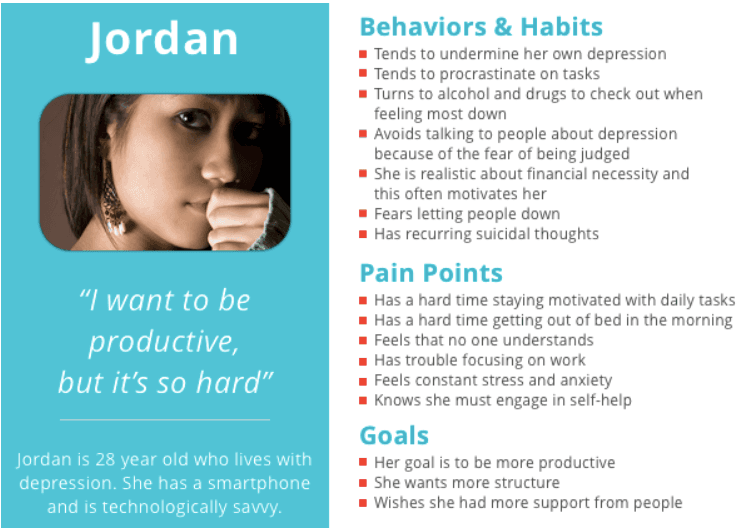
- —Even though our client expressed that the user group would be anyone and everyone living with depression, as UX designers we knew that having a clear and refined idea of who the user is is essential for an effective solution.
- —We explored the problem space of depression and those living with it by recruiting people with diagnosed depression for interviews. We validated that Mood Coach's users would be people with diagnosed depression, a belief in the power of self-help, and a desire to improve their current situation.
Data analysis
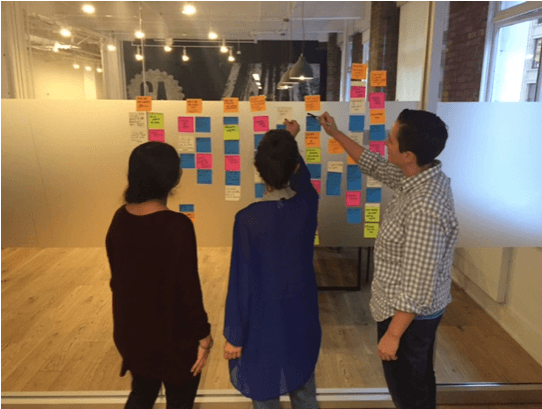
- —Our interviews made clear that the commonalities between interviewees included difficulty staying motivated with mundane tasks and a strong desire for a nonjudgmental community.
- —We then performed usability tests on Mood Coach with our target users and grasped that the main issue with its usability was confusion revolving the onboarding process, the significance of values, setting up plans, and general functionality.
- —We found that the changes we implemented — streamlined onboarding, clarified plan set-up, and facilitated value-activity relationship — have indeed aligned with our users' needs.